
Oneida County Parole Versus Probation
Parole and probation both permit a person to live in the community under rules, yet they begin in different ways. Parole follows an Idaho prison term and requires action by the Idaho Commission of Pardons and Parole. Probation is ordered by a court, often instead of prison or after a suspended term. Idaho Department of Correction, or IDOC, supervises state probation and parole. Oneida County also operates local probation and pretrial programs, so the court file and IDOC record must be read together.
A person can be physically released from Caribou County Jail and still face pretrial monitoring, probation, or a later IDOC commitment. Likewise, an IDOC result of “In community” means the person is outside an IDOC prison but remains on the active sentence shown. It does not mean the sentence has ended. Final parole discharge and court-ordered probation termination require different proof.
| Point | Parole | Probation |
|---|---|---|
| Authority | Idaho Commission of Pardons and Parole | Sentencing court |
| Usual starting point | Release from an IDOC prison sentence | Court order, sometimes after county custody |
| Public evidence | IDOC “In community,” sentence status, and Released to Supervision | IDOC record when state-supervised, plus the court docket or order |
| End record | Commission discharge notice, called a Gold Seal | Court termination or discharge order |
- Parole
- Conditional community release from an Idaho prison sentence.
- Probation
- Court-ordered community supervision that may be imposed without prison.
- Discharge
- The formal end of the sentence or supervision covered by the record.
- Absconder
- A supervised person alleged to have stopped reporting or left required supervision.
Check Oneida County Supervision
The official IDOC Resident/Client Search is the strongest public starting point for state supervision. It accepts a last name or IDOC number. A first name is optional. Partial searches require at least two last-name letters or three IDOC digits. Compare birth year, middle name, IDOC number, and sentencing county because IDOC warns that one person can have more than one number.
- Search the full last name or known IDOC number and narrow with the first name.
- Open the closest record and read the exact status. “In community” differs from “Discharged [date].”
- Inspect sentence status for Probation or Parole, Released to Supervision, Sentence Satisfaction Date, Supervising District, officer, and phone.
- Match the sentencing county and case number in Idaho iCourt. The public search uses the name order
Last, First. - Call the displayed officer or District 6 when current confirmation is important. Ask for an official discharge record when the issue is whether supervision ended.
IDOC says its database updates daily, but fast changes can lag. A court order and an IDOC field can describe different parts of the same case. Preserve each source’s exact wording rather than converting every community event into “released.” The broader Oneida County search and release-record path is available on the released inmates home page.
Oneida County Supervision Offices
Oneida belongs to IDOC Probation and Parole District 6. The district mirrors the Sixth Judicial District and covers Oneida, Bannock, Bear Lake, Caribou, Franklin, and Power counties. Its published offices are in Pocatello, Preston, and Soda Springs. The district page does not assign every Oneida client to one satellite. Use the officer and phone displayed in the individual IDOC record first. If none is shown, call the main office rather than guessing which satellite holds the file.
IDOC District 6
1246 Yellowstone Avenue, Suite F
Pocatello, ID 83201-4310
208-237-9194
Preston satellite: 16 S 1st W, 208-852-3017
Soda Springs satellite: 159 S Main, 208-547-1813
The official District 6 page supplies current regional contacts. Supervision information can be confidential. A listed office may confirm routing or explain a public field without disclosing protected case details.
The manifest image below illustrates District 6 coverage and contact information. It should be used to locate the right office, not to infer an individual’s status.
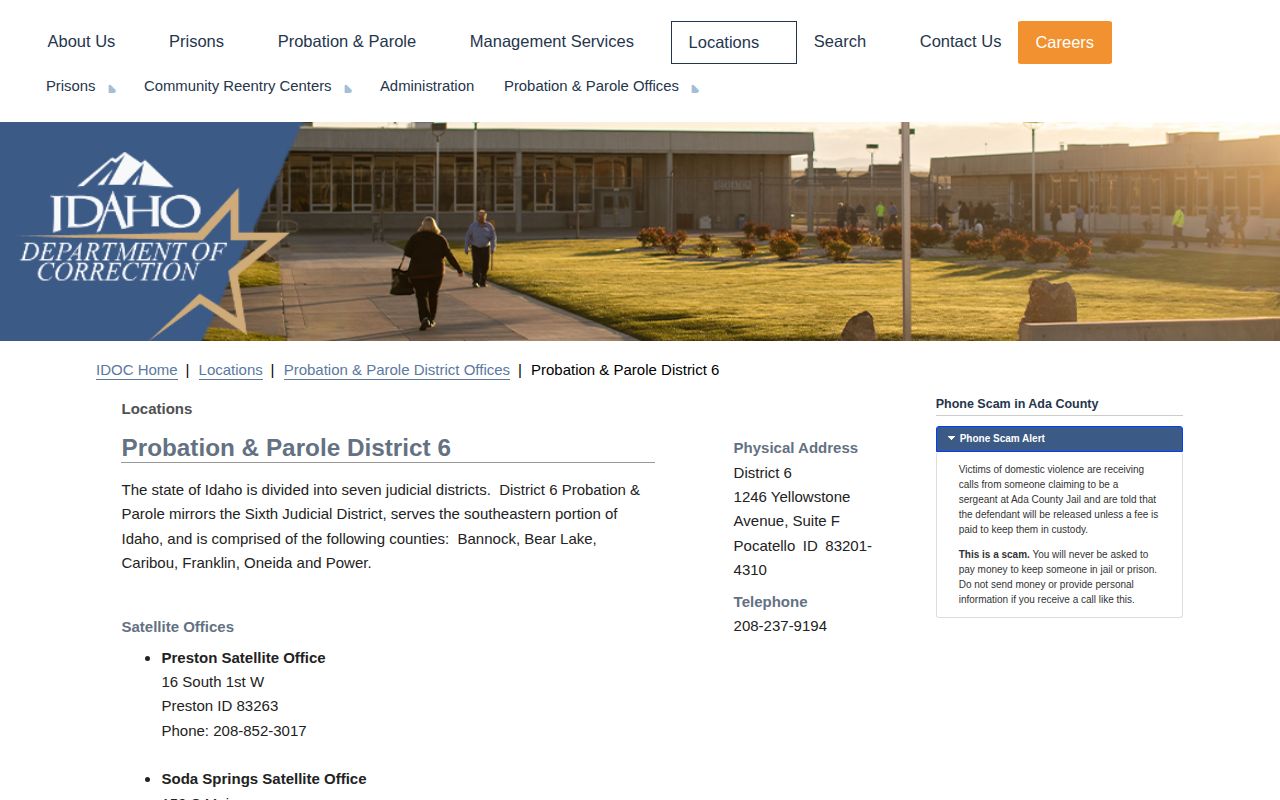
The person-level IDOC record remains the better source for the assigned officer and current supervision fields.
Oneida County Probation Handoff
Oneida County’s local probation office forms a distinct local-to-state handoff after release. It lists pretrial services, GPS monitoring, drug testing, Drug Court Services, adult and juvenile supervision, and treatment-resource navigation. Those functions can begin after a bond or court release even though parole is not involved. The office also identifies a felony IDOC probation and parole contact, linking county services to the state system.
Chief Gabriel Jimenez is listed at 208-766-4116 extension 3000 and gjimenez@oneidaid.us. Deputy Chief Kristi Christophersen is listed at extension 3001. Felony Probation and Parole Officer Melissa Peck is listed at 208-237-9194 extension 232 and mpeck@idoc.idaho.gov. These are navigation contacts. Staffing can change, and the listing does not promise disclosure of a person’s confidential case facts.
Oneida County Probation
30 N 100 W
Malad, Idaho
208-766-4116
The official Oneida Probation page is the source for these roles and contact details. The screenshot captures the local mix of supervision and treatment-resource functions.
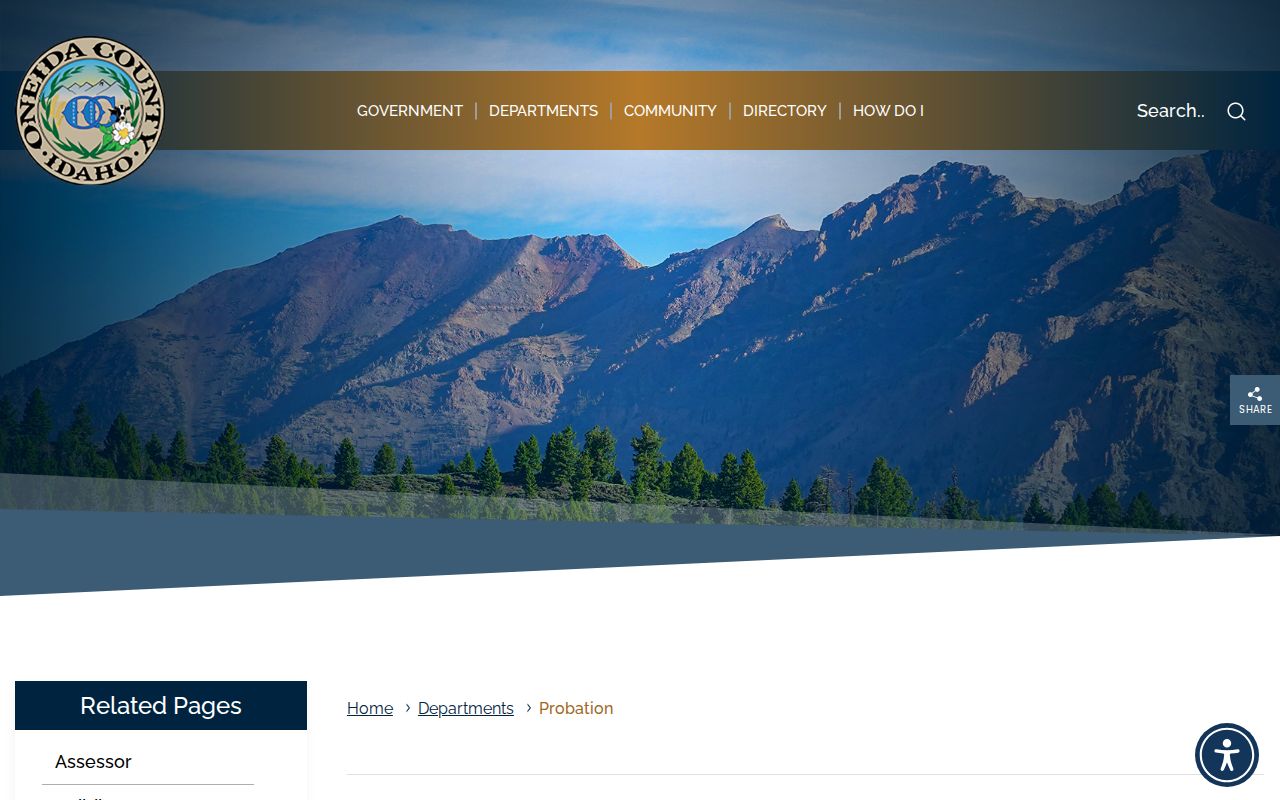
This local page helps route a question, while IDOC and the court supply the controlling public status and order.
Oneida County Warrant Status
An “Active Bench Warrant” can appear in the IDOC search. IDOC also publishes a selected Fugitive Recovery Most Wanted list and a tip route. The two sources are not interchangeable. Absence from a selected Most Wanted list does not prove that no warrant exists, and it does not establish that supervision ended.
Match the person record, supervising office, and the relevant court or law-enforcement source. A warrant is a court or agency command to take the person into custody. An absconder label concerns an alleged failure to remain in contact or comply with supervision. Neither should be inferred from a missed appointment, a rumor, or a name-only match. If immediate safety is involved, use law enforcement rather than an office email.
VINE can send custody movement or status alerts, but it is not a probation compliance ledger. The service is best used for a named person’s custody changes. It cannot replace the IDOC sentence detail, officer confirmation, or court docket.
End Oneida County Supervision
Supervision ends through a formal source, not through silence. For parole, the Commission FAQ says an official discharge notice known as a “Gold Seal” is sent to the last supervision district for forwarding. Delivery may take up to a month. That document is stronger evidence of completed parole than roster absence, a missed VINE result, or an old office listing.
Probation termination is a court matter. Search the Oneida case in iCourt for a termination or discharge order, then request the actual document from the clerk if needed. Idaho Code section 74-102 supports access to public records at reasonable times, subject to exemptions and court restrictions. Sealed or shielded material may not appear in the portal. A public no-result does not prove there was no case or supervision.
IDOC may retain a results-list entry reading “Discharged [date]” after a sentence is satisfied, while old convictions no longer appear in that presentation. Read that result narrowly. It supports the completion date shown for the IDOC sentence, but it does not reconstruct every earlier offense, jail exit, or release type. When sources differ, the Commission owns its parole decision, IDOC owns state status, the court owns probation orders, and Caribou owns the physical jail exit.
Note: Current officer assignment should be checked in the person’s IDOC record because regional office coverage does not identify every Oneida case.
Resolve Oneida Supervision Conflicts
When IDOC shows “In community,” inspect the whole active record before deciding what it proves. Sentence status identifies Probation or Parole. Released to Supervision records the most recent placement under supervision, while Sentence Satisfaction Date shows the endpoint currently displayed for that sentence. Supervising District, officer, and phone identify the best route for a current question. “In community” is strong evidence that the person is not confined in an IDOC prison, but it does not mean every sentence term has been discharged.
If Caribou says a person went to IDOC, treat that event as a transfer. Search IDOC by last name or IDOC number and compare birth year, middle name, sentencing county, and case. An initial public miss does not cancel the verified transfer because IDOC warns that rapidly changing facts can lag in its daily-updated display. The accurate interim statement is that Caribou reported a transfer and the public state result has not yet been confirmed.
A court order and a supervision record can also coexist without conflict. The Oneida court owns a probation order or termination decision. IDOC owns its state supervision status. The Commission owns parole action and discharge. Caribou owns the physical jail exit. Match the same person and case across those sources, then ask the agency that created the disputed field to correct or explain it. This prevents a jail departure, a parole grant, and final sentence discharge from being treated as one event.
For final proof, request the actual court termination order or Commission discharge notice instead of relying on a search absence.
Public Record Search
Sponsored Results