
Oneida County Projected Versus Actual
“Projected release date” is a useful search phrase, but Idaho’s official records use more exact terms. IDOC active details can show Parole Eligibility Date and Sentence Satisfaction Date. The Idaho Commission of Pardons and Parole may grant a TENTATIVE parole date. A later Released to Supervision field records a completed move to community supervision. Each date answers a different question.
A person held before trial at Caribou County Jail does not have an IDOC prison calculation merely because the arrest occurred in Oneida. The court may authorize bond, dismissal, time served, or another result, but Caribou still processes the physical exit. A different case, warrant, detainer, identity issue, incomplete bond, or transfer can delay or prevent community release. No official Caribou release-hour or processing schedule was verified.
A court order may be valid while the person remains held for processing or another authority. Match the Oneida case number and order with Caribou’s exit record. If Caribou reports transfer to IDOC, leaving the jail is not release from custody.
Find Oneida County Release Dates
Begin with custody type. Oneida County has no jail or holding facility. Its detained people go to Caribou County Jail in Soda Springs. That arrangement makes a search for a fictitious Oneida jail release calendar unreliable. The correct route combines the jail, Oneida court, and IDOC only when state custody is involved.
- For an Oneida arrest, call Caribou Jail at 208-547-3094. Ask whether the person remains held, was released to the community, or was transferred.
- Search Idaho iCourt by case number or
Last, First. Read bond, release, judgment, sentence, and amended orders. - If the jail reports an IDOC commitment, use the IDOC Resident/Client Search. Search by last name or IDOC number and compare birth year and middle name.
- Open the active sentence detail. Keep PED, Sentence Satisfaction Date, and Released to Supervision separate.
- For parole, inspect the Commission’s notice and confirm later through IDOC “In community” or another completed status.
- Request the custody or sentence record from the agency that owns the disputed calculation.
The home page contains the full Oneida County released inmate search and record path. A county jail-only stay may never appear in IDOC. Conversely, an IDOC status can lag a verified transfer from Caribou, so recheck without undoing the custodian’s confirmed fact.
Oneida County IDOC Date Fields
IDOC requires a last name or IDOC number. First name is optional. Partial entries accept at least two last-name letters or three IDOC digits. Results can show “In custody,” “In community,” “Active Bench Warrant,” “Out of State Custody,” or “Discharged [date].” An active detail can show location, sentencing county, case number, sentence status, offense, and the date fields used for planning.
| Idaho field | Meaning |
|---|---|
| Parole Eligibility Date | The earliest potential parole point, generally when the indeterminate portion begins. It is not a grant. |
| TENTATIVE parole date | A Commission-approved possible date that depends on prerequisites and can change or be voided. |
| Sentence Satisfaction Date | The displayed endpoint for the active sentence calculation. |
| Released to Supervision | The date the person was most recently placed on supervision by a court or the Commission. |
| Discharged [date] | A results-list status supporting completion of the IDOC sentence shown. |
The official IDOC search form shows the available lookup route and its scope warning.
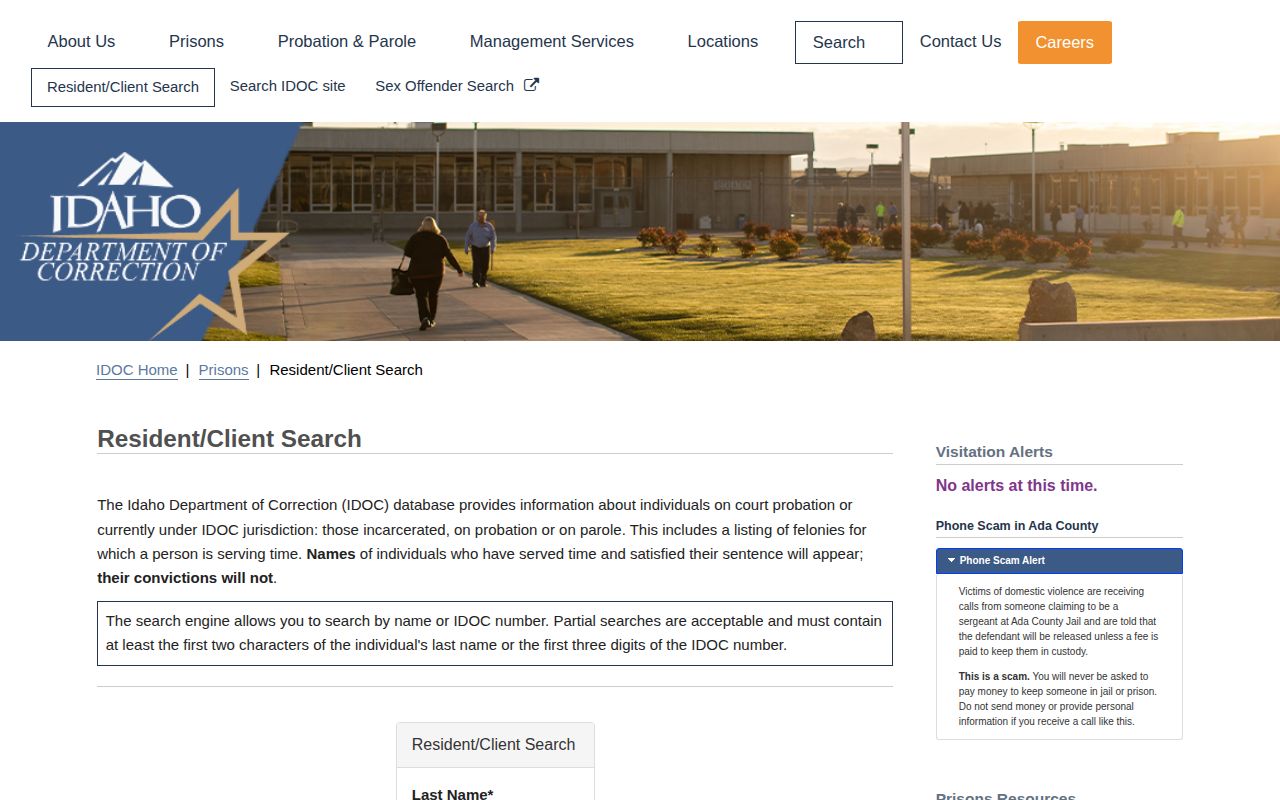
This statewide search serves Oneida people only when court probation or IDOC prison, probation, or parole jurisdiction exists.
Idaho Fixed-Term Release Rules
Idaho Code section 19-2513 requires a court to set a minimum fixed, or determinate, confinement term and may add an indeterminate portion. During the fixed term, the person is ordinarily not eligible for parole or discharge and does not receive ordinary good-conduct credit or reduction. That is why Idaho should not be described with a broad “serve about 85 percent” rule.
The reliable shorthand is narrower: the fixed portion ordinarily must be served before parole eligibility, then parole during the indeterminate portion remains discretionary. With multiple sentences, the Commission FAQ says the latest indeterminate-begin date controls PED. A PED still does not command release. It opens the possibility of parole consideration under the sentence and Commission rules.
Idaho has limited exceptions, but they are not a routine earned-time discount. Idaho Code section 20-101D allows a capped reduction for extraordinary meritorious service, such as qualifying lifesaving or heroic acts. Section 20-1006 provides a medical-parole path for qualifying terminally ill or permanently incapacitated people when the Commission makes the required safety finding. Neither provision should be applied to an individual without the official decision.
Note: A fixed term and an indeterminate term are sentence parts, while a tentative parole date is a later Commission action.
Oneida County Jail Date Calculation
County jail dates use a different record set. No official Oneida or Caribou policy was found for county-jail good time, weekend adjustment, release-hour calculation, or credit display. Do not apply IDOC prison PED logic to a short county sentence. Use the sentencing order, credit-for-time-served entry, and Caribou custody record.
Credit for time served means the court gives recognized prior custody time toward the sentence. It does not, without the order and jail calculation, tell the exact hour the person will leave. Ask Caribou to explain the existing computation when the order date and expected exit differ. If the person is pretrial, the answer may instead depend on completion of bond, release terms, and any separate hold.
A narrow records request should identify full name, date of birth, Oneida case number, booking date, and the date field in question. Ask for the existing booking and custody-disposition record, including release date and time, reason, and receiving authority if transferred. Caribou owns the physical booking and exit record; Oneida court owns its sentence and orders.
Changes to Oneida Release Dates
A displayed date can move because it describes a forecast or an active sentence rather than a completed exit. The source record should explain which factor applies. Avoid assuming discipline, a hold, or a parole outcome without an official entry.
| Factor | Possible effect | Best source |
|---|---|---|
| Court order or amended judgment | Changes sentence terms, credit, or legal authority for release | Oneida iCourt and clerk |
| Other case, warrant, or detainer | Can keep the person held or cause transfer after one case authorizes release | Jail custody record and originating authority |
| Parole grant or later action | Creates, changes, rescinds, or defers a possible parole date | Commission Notice of Action |
| Programs and parole plan | Unmet prerequisites can delay a tentative parole release | Commission notice, IDOC, supervising office |
| Sentence recalculation | May alter the displayed endpoint or credit | IDOC or the county custodian for its own sentence |
| Transfer | Ends custody at one facility but continues it under another authority | Sending and receiving agency records |
Commission decisions are generally published by the end of business Friday after the hearing. Use the notice’s exact action. A grant, denial, review, deferment, rescission, or revocation event should not be rewritten as a generic release result.
Read Oneida Parole Decisions
The Commission decisions page warns that parole dates are tentative. Before community release, the PED must arrive and required programming, an approved parole plan, transportation, paperwork, and the signed contract must be complete. A hearing decision is a decision record, not a gate-exit record.
The manifest illustration below is an IDOC active record used to demonstrate date labels. It is not an Oneida County subject and should not be read as local person data.
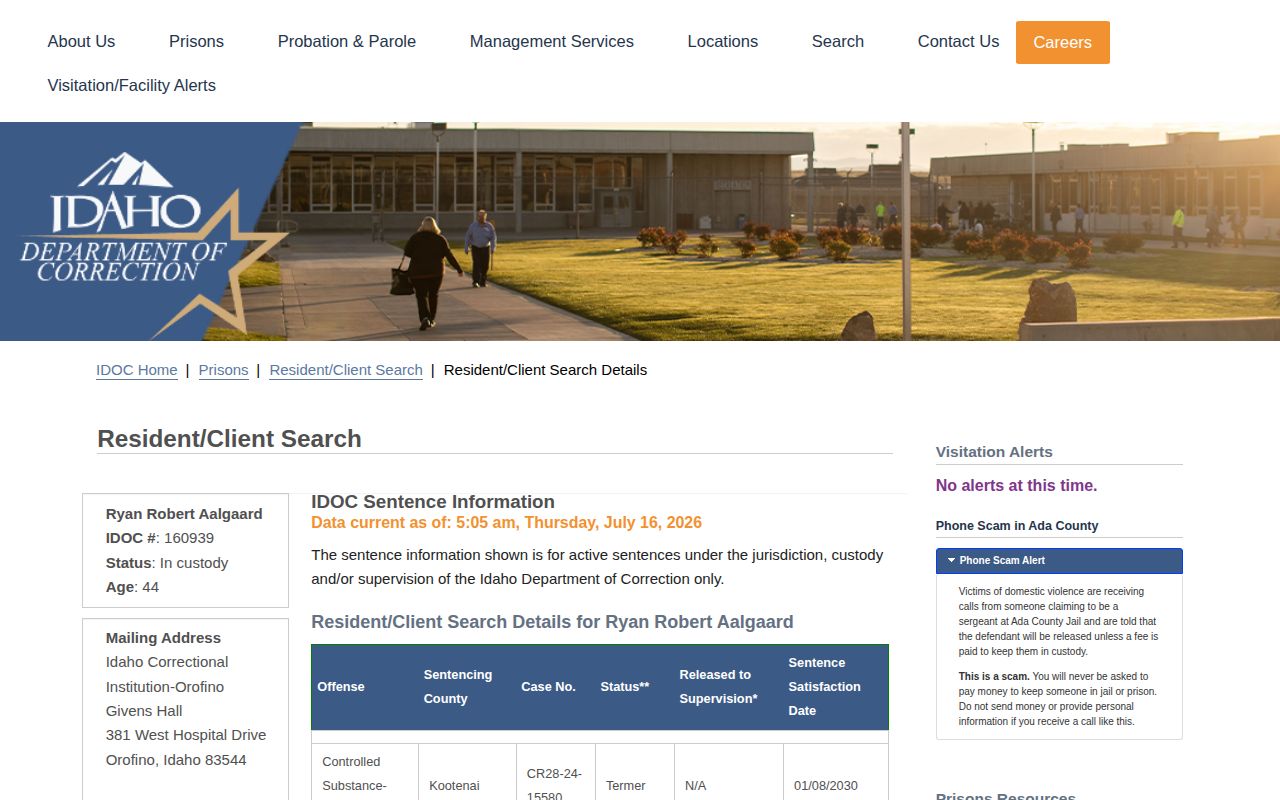
The image shows why PED and Sentence Satisfaction Date must remain distinct in an Oneida County release-date lookup.
If a tentative date passes without IDOC showing “In community” and Released to Supervision, do not assume the person left. Recheck the Commission notice and IDOC. Data update daily and can lag, but an unmet prerequisite or later action may also explain the difference.
Confirm Oneida County Release
Actual release must be confirmed in the system that held the person. For Caribou County Jail, ask for the completed exit date, time, disposition, and destination. Pair that record with the Oneida court order. For IDOC, “In community” plus Released to Supervision supports a completed move to parole or probation, while “Discharged [date]” supports completion of the displayed IDOC sentence.
VINE can add a named-person alert. Register for release or transfer notice, then confirm the change with the reporting jail or IDOC. The Oneida County VINE inmate check explains the four-digit phone PIN, transfer re-registration, and source timing. An alert does not replace the sentence or custody record.
When sources seem to conflict, ask whether they describe different moments. A court release order and a jail exit hours later can both be correct. A Commission grant and IDOC “In custody” can coexist while prerequisites remain. A Caribou exit followed by IDOC admission is a transfer, not community release. Match name, date of birth, case number, IDOC number, and event date before deciding that records disagree.
Oneida County Date Disputes
If iCourt shows a bond or release order while Caribou still reports custody, first confirm that the order belongs to the same person, booking, and case. Legal authority does not guarantee an instant exit. Processing, bond completion, another case, a warrant, a detainer, identity reconciliation, or transport may affect the actual time. Ask Caribou whether the order has been executed and whether another receiving authority appears in the disclosable custody record.
If IDOC shows “Discharged [date]” but no historical conviction detail, read the result within IDOC’s stated scope. The agency says names of people who served time and satisfied their sentence remain while convictions do not. The displayed date supports completion of the represented IDOC sentence. It does not establish the exact date the person left prison if community supervision followed, nor does it describe every earlier offense or release type.
For a parole date dispute, open the Commission Notice of Action Taken and preserve its exact term. A grant with a tentative date still depends on reaching PED, completing programs, gaining approval of the parole plan, arranging transport, and finalizing paperwork. If the tentative date passes without IDOC showing “In community” and Released to Supervision, recheck both official sources. Do not convert the unconfirmed date into an actual release.
Public Record Search
Sponsored Results