
Oneida County VINE Coverage
VINE means Victim Information and Notification Everyday. Idaho provides free automated phone, text, and email updates about reported custody movement or status changes. The Idaho fact sheet describes coverage for people in participating county jails and Idaho prisons. Oneida County does not operate a jail. Its official detention page says incarcerated people are taken to Caribou County Jail in Soda Springs, so the reporting jail or IDOC source must be checked on each match.
The Idaho VINELink route is designed for one-person searches and notifications. It is not a historical discharge archive. A release alert reports a change received from a participating source. It may not explain whether the event was bond, time served, parole, dismissal, or transfer. Those details belong to Caribou’s closed custody record, an IDOC record, or the Oneida court case.
Search Oneida County VINE Records
Start with the person’s legal name or offender ID. Add accurate identifying details before treating a match as the same person. Oneida arrests create a two-county path: Oneida owns the arrest and case material, while Caribou handles the jail event. An IDOC entry applies only if the person entered state jurisdiction or state supervision.
- Open Idaho’s VINELink route and select Idaho when prompted.
- Enter the person’s name or offender ID. Try a full legal name before alternate spellings.
- Compare the name, number, reporting jail or IDOC location, and other visible identifiers.
- Open the matching record and preserve its exact status, facility phone, and any scheduled date shown.
- If no result appears, correct the spelling and identifier, then contact the likely custodian. A miss does not prove release.
Multiple matches require care. Do not choose a person by name alone. A birth year, offender number, facility, and known arrest date can separate namesakes. If the event began in Oneida, Caribou Jail can be reached at 208-547-3094 to ask whether the person remains physically held, left for the community, or transferred.
A broader source-by-source path appears on the Oneida County released inmates page. Use that path when the reporting authority is uncertain rather than forcing a VINE result to answer every custody question.
Oneida County VINE Fields
The Idaho documentation states that VINE may return the person’s name and number, current custody status when held, location, facility phone, and a scheduled release date when available. Availability matters. The research did not ethically select a live released person merely to test the interface, so no literal post-release screen label is promised here.
| Field | How to read it |
|---|---|
| Name or offender number | Identifiers used to compare the record with the known person. |
| Custody status | The latest status supplied by the participating source, not a certified discharge document. |
| Location | The reporting facility or custody location when available. |
| Facility phone | The contact for confirming the source record and asking about release or transfer detail. |
| Scheduled release date | A date shown when available. It may be projected and can change. |
Read a status change in context. A transfer alert means custody may continue elsewhere. A release alert can show that the reporting source sent a release event, but it does not by itself establish sentence completion. For an IDOC case, compare “In community,” Released to Supervision, Sentence Satisfaction Date, and “Discharged [date].” For a county case, ask Caribou for the actual exit time and disposition.
Note: The agency that originated a disputed fact remains the best correction source, even when VINE delivered the first alert.
Register Oneida County Release Alerts
Registration begins after the correct person is found. Website registration can use a telephone number or email address. The toll-free phone route supports telephone registration. The Idaho documentation permits multiple phone and email registrations, which can help when more than one person needs notice. Do not use a switchboard number because the alert must reach someone able to confirm receipt.
- Open the matching person record and choose notification registration.
- Enter a phone number with area code, an email address, or both where the interface permits.
- For telephone notice, choose a four-digit PIN that can be recalled safely.
- When the automated call arrives, enter the PIN to confirm receipt and stop repeat calls.
- Update changed contact details and re-register after a transfer when the service instructs.
The PIN has one narrow job. It confirms receipt of a telephone notice. It is not an offender ID, a case number, or a portal password. If calls must stop and the PIN has been forgotten, IDOC directs users to the Idaho VINE line at 866-984-6343. IDOC victim-services assistance is listed at 208-605-4774 during business hours.
Alerts can cover release, transfer, and escape. That breadth is useful, but each term describes a different event. A transfer can require a new registration because a new facility becomes the reporting source. Silence after a transfer should never be translated into final release.
Oneida County VINE Update Timing
Idaho’s official fact sheet documents unusually specific source-transfer intervals. It describes county jail data transfers every 15 minutes, IDOC transfers at 5 a.m., noon, 9 p.m., and midnight, and court data transfers daily. Those are the fact sheet’s documented intervals. They are not a live-tested service guarantee or a promise that every source field appears within a fixed maximum time.
Short delays can occur between a jail action and the public notice layer. A missing result can also stem from spelling, an offender ID error, transfer, source participation, or the person never having been in the searched jurisdiction. Search an alternate name form, then go back to Caribou for a local jail event or IDOC for state custody. Preserve a verified transfer even if the receiving system has not yet updated.
The official Idaho VINE fact sheet explains both the notification steps and this source cadence. Because the manifest capture failed for the PDF, no unrelated image is substituted.
Confirm Oneida County VINE Alerts
When VINE sends a release notification, record the time, reporting agency, person identifiers, and stated change. Then contact the reporting source. If the alert concerns Caribou County Jail, match it with the Oneida iCourt case and request the booking or release record when the reason, actual exit time, or destination matters. If it concerns IDOC, use the Resident/Client Search and read the exact status and date fields.
Federal and immigration paths are separate. The BOP locator covers federal prisoners and can display RELEASED or a release date. “Not in BOP Custody” can also mean another authority holds the person. ICE’s locator primarily covers current ICE custody or longer CBP custody and is not a historical release archive. Neither system should be used for an ordinary Oneida county case without a verified transfer or federal connection.
The court supplies legal authority and disposition, not necessarily the physical exit time. A bond or release order can appear before jail processing ends, and another hold can delay departure. Caribou owns the jail exit transaction; Oneida court owns its docket; IDOC owns state custody and supervision status. This source split resolves most apparent conflicts.
Registry Alerts Are Not VINE
The Idaho State Police sex-offender registry offers a distinct email subscription for a selected registrant’s move into or out of Idaho. That can be useful when the person has a statutory registration duty, but it tracks registry relocation. It does not report a jail release and cannot replace VINE when a custody change is the question.
The registrant-move subscription is tied to one registry record. The registry itself can be searched by name, city, county, ZIP, or map radius, including Oneida County. ISP warns that name and date comparisons are not conclusive and that fingerprint comparison is the positive identification method. Some addresses also cannot be mapped.
The source image below shows the Idaho registry’s county and name search context. It is included to clarify the separate registry channel, not as evidence that a person was released.
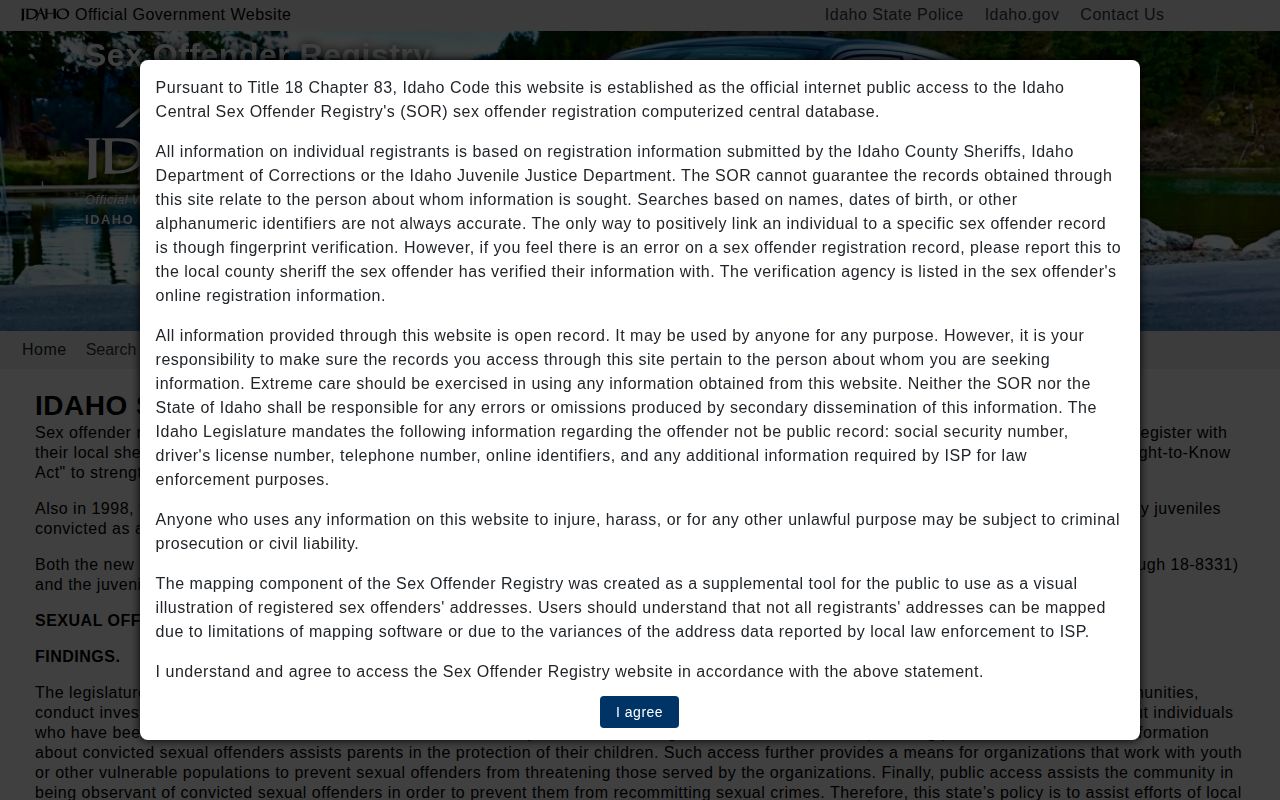
A registry match or move email answers a registration question only. A VINE alert, jail record, or IDOC status is still needed for custody and release.
Oneida County VINE No-Result
A no-result does not prove release. The name may be misspelled, the offender ID may be wrong, the person may have transferred, or the searched source may not yet reflect the event. The person may also never have been in the jurisdiction selected. Try alternate legal name forms and the known offender number, then return to the agency most likely to hold the person.
For an Oneida arrest, the local fallback is Caribou County Jail plus the Oneida court case. Call Caribou and ask whether the person remains physically held. If not, request the exit date, disposition, and receiving authority. Search iCourt by case number or Last, First for the legal order. For state custody, use IDOC. A county jail-only case may never appear in the statewide corrections search.
Use specialized systems only after the record identifies that path. BOP covers federal custody, while ICE ODLS primarily covers current ICE or qualifying CBP custody. The Idaho registry applies only to people with a registration duty. None can fill a missing VINE result for an ordinary Oneida jail event. The receiving authority’s record must confirm a transfer before that source is treated as controlling.
If a prior alert named a reporting facility, keep that detail. Call the facility and match the alert time, offender number, full name, and known case. Ask which event its system reported. A release, transfer, or escape notice should retain its own label. If the record was corrected after an alert, request the source agency’s current explanation rather than guessing why VINELink changed.
Public Record Search
Sponsored Results